
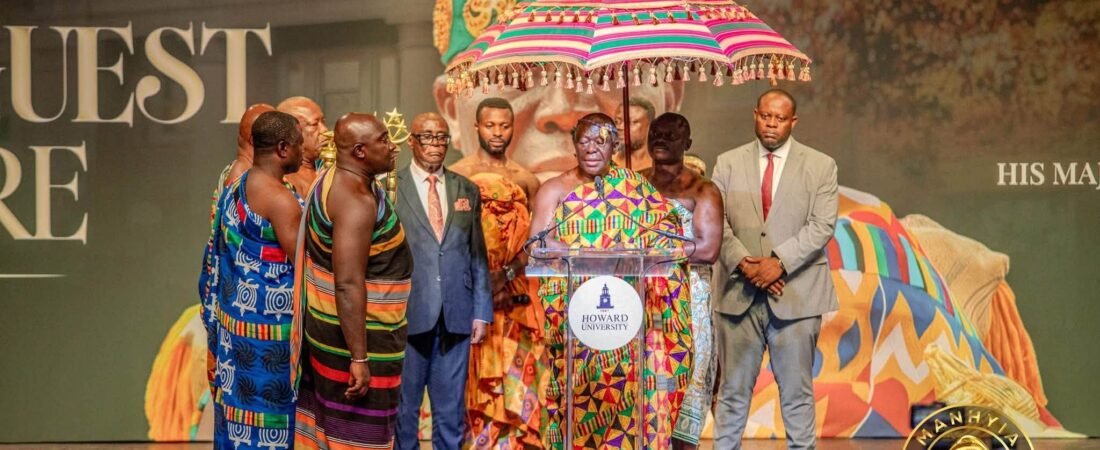
There are chiefs, and then there is the Asantehene.
Before anyone accuses me of disrespecting the rest of the chieftaincy institution, allow me to explain.
This is not an insult to anybody. It is simply an observation.
Because there is something about the entrance of the Asantehene that makes you reconsider your own behaviour.
You could be sitting comfortably, scrolling through your phone, laughing at a video and minding your own business.
Then you hear:
“Otumfuo is coming.”
Suddenly, the phone is no longer interesting.
Your back straightens.
Your legs come together.
Your voice becomes quieter.
And somehow, even your clothes begin to feel like they need to behave themselves.
Nobody has told you to sit properly.
You just know.
That is the Asantehene effect.
Some people enter a room and people notice.
Some enter and people clap.
Some enter and people take pictures.
Otumfuo enters and the room seems to understand that something has changed.
Even people who were talking loudly suddenly discover the beauty of silence.
And if you have ever watched a gathering when Otumfuo arrives, you will understand what I mean.
There is a particular seriousness that accompanies the moment.
The conversations pause.
The cameras come out.
People look towards the entrance.
The atmosphere changes.
It is almost as if the room itself has been informed that the Asantehene has arrived and has decided to cooperate.
But perhaps that is what happens when a person carries more than a title.
The name Otumfuo Osei Tutu II does not exist in isolation.
It carries history.
It carries the Golden Stool.
It carries Manhyia.
It carries the weight of the Asante Kingdom and generations of tradition.
So when he walks into a room, people are not simply responding to the man standing before them.
They are responding to everything the stool represents.
And that is why the Asantehene can make something as ordinary as sitting down look ceremonial.
There is also something amusing about the way people behave around him.
People who normally have no problem talking suddenly become very careful with their words.
People who are usually late suddenly understand the meaning of punctuality.
People who would ordinarily walk into a room without looking twice suddenly become very interested in their posture.
You can almost hear the internal conversation:
“Am I sitting well?”
“Is my phone on silent?”
“Should I stand?”
“Wait, has he seen me?”
It is the kind of presence that makes you check yourself without being asked.
And perhaps that is the real distinction.
Authority can be announced.
Presence cannot.
You can put someone’s name on a programme.
You can introduce their title.
You can list their achievements.
But there are people whose presence does the introduction before the master of ceremonies gets the microphone.
Otumfuo is one of them.
So yes, there are chiefs.
There are many respected chiefs.
There are traditional leaders whose names and stools carry great significance.
But the Asantehene occupies a particular place in Ghana’s traditional landscape.
And perhaps the easiest way to explain it is this:
Some people walk into a room.
Some people command a room.
And then there are those whose arrival makes the room itself sit up.
That is the Asantehene.